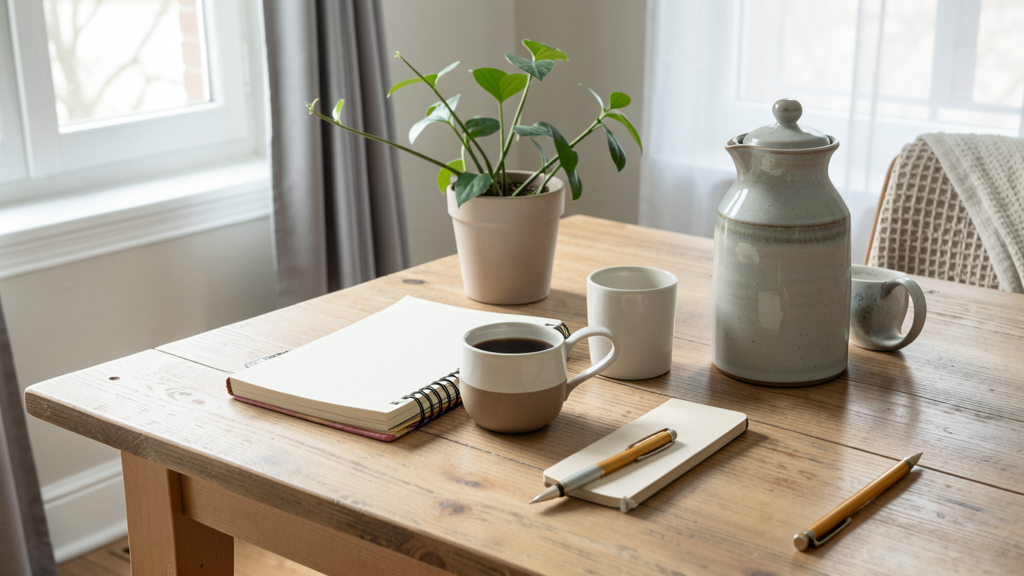
Daily Rituals
4 Signs Your 'Work From Home' Transition Ritual Isn't Working
If you can't mentally disconnect because your bedroom doubles as a boardroom, your transition ritual needs an immediate overhaul.
6 min read
 Practical guides to Lifestyle and inspiration
I stopped trying to overhaul my life at 9 PM and started stacking 30-second actions onto existing triggers to finally catch some sleep.

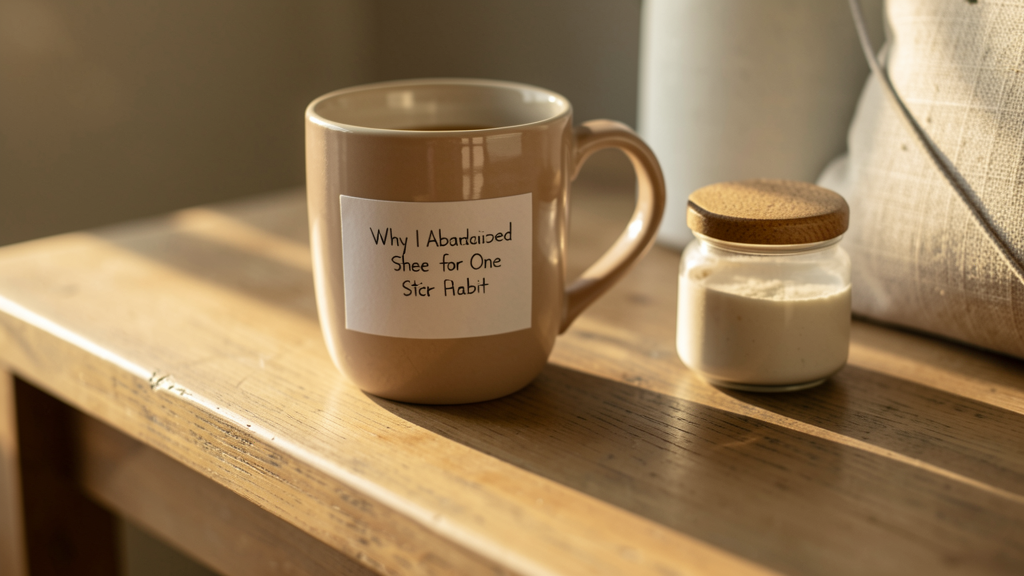
Editorial image illustrating Why I Abandoned the 10-Step Routine for One Sticky Habit
The crash was audible, though mostly metaphorical. It was 11:45 PM on a Tuesday in late January 2026, and I was sitting on the floor of my home office, staring at a half-packed carry-on and a to-do list that seemed to reproduce while I blinked. I was supposed to be in bed, skin slathered in expensive actives, mind cleared of the day’s editorial chaos. Instead, I was doom-scrolling through runway archives I had seen a hundred times before, hyped up on caffeine and anxiety.
For years, my evening routine was a rigid, beautiful construct on paper. It involved a digital sunset at 9 PM, a forty-minute yoga flow, journaling, and a strict skincare regimen. It worked when I was on vacation in Tuscany or staying at a minimalist hotel in Tokyo, but in real life? It was a house of cards. If I missed the 9 PM cutoff, I figured the whole night was ruined, so I might as well just keep working until my eyes burned.
The problem wasn’t that I lacked discipline. The problem was that my routine required a version of myself that didn't exist after 14 hours of back-to-back Zoom calls. I needed something that could survive a bad day, something that didn't require willpower I had already spent by noon.
The turning point came not from a productivity guru, but from a conversation with a cognitive behavioral therapist I interviewed for a piece on burnout. She mentioned that the brain resists "new" behaviors but accepts "attached" behaviors. That weekend, I scrapped the 10-step routine. I didn't replace it with a simpler version; I replaced it with a sequence of micro-habits so small they felt ridiculous, linked to things I already did automatically.
My failure was specific. I treated my evening like a second shift. I had a transition ritual that was essentially a job change: from "Travel & Style Editor" to "Zen Master of Relaxation." But as I explored in a previous discussion on why our boundaries fail, the friction between work mode and rest mode was too high. The mental load of deciding to start a complex routine was often the very thing keeping me awake.
On February 3rd, I decided to stop trying to be Zen. I decided to be strategic. I identified the one thing I did every single night without fail, regardless of how chaotic my day was. It wasn't meditation or stretching. It was brushing my teeth. It was the non-negotiable anchor.
The theory, often called Habit Stacking, is simple: you use a neural pathway that is already carved deep (the trigger) to build a new, tiny bridge (the micro-habit). The genius lies in the specificity. I didn't say, "I will relax after brushing my teeth." That is too vague. I said, "After I rinse my toothbrush, I will put my phone on the charger in the kitchen."
This was the first domino. I needed to break the physical link between my bed and my scrolling. By moving the charger six meters away to the kitchen counter, I created a spatial barrier. I wasn't relying on willpower to not look at Instagram; I was relying on the fact that I was too lazy to walk back to the kitchen once I got into bed.
Once the phone was docked in the kitchen—my first trigger successfully executed—I felt a void. Usually, I would walk into the bedroom and immediately start looking for distractions. I needed a filler that wasn't digital. I looked back at my visual environment. I realized I often forgot to drink water in the evening because the glass wasn't there. I applied the logic of visual cues to this next step.
The next trigger was walking through the bedroom door. The micro-habit? Turning off the overhead light and turning on the warm salt lamp on the dresser. That’s it. Just a switch.
Then, I walked to my bedside table. The habit here was to pick up the book I was currently reading—The Seven Husbands of Evelyn Hugo, for the third time—and open it to the bookmark. I didn't commit to reading a chapter. I just committed to opening the book.
The change happened on February 14th. I had a terrible day. A photoshoot in São Paulo got rained out, and I spent six hours rescheduling logistics. I got home at 9 PM, exhausted and craving a glass of wine and a documentary. I didn't have the energy for a "routine." But I did brush my teeth. And when I rinsed the brush, my brain kicked in. I walked to the kitchen, plugged in the phone, and watched the battery icon light up. I walked to the bedroom, flipped the harsh light off, turned the salt lamp on, and picked up the book.
I didn't read. I held the book for two minutes, realized I was too tired, and put it down to sleep. But the sequence had been followed. The "wind-down" had occurred without me feeling like I was performing a task. It was just gravity.
The success of that night encouraged me to refine the stack. I realized the specificity of the triggers was what made it stick. I wasn't saying "at night," I was saying "after X." This removed the need for decision-making. Decision fatigue is the enemy of the evening routine.
By March, my stack looked like this:
Notice there is no "meditate for 20 minutes" or "write five things I’m grateful for." Those are high-friction tasks. If I feel grateful, I might jot it down, but it’s not the rule. The rule is the blinds. The rule is the water.
I also had to address the environment. If my desk was cluttered with unpaid bills or half-written editorials, the visual noise would spike my cortisol the moment I walked in the room. This is where my Sunday routine became crucial. I realized that clearing the physical space on Sunday afternoon made the evening stack frictionless. If the room was already a sanctuary, the micro-habits could just flow through it.
I want to be honest about the trade-off. This method is not glamorous. You will not get the dopamine hit of crossing off a massive "Self-Care" checklist. There are days when I miss the elaborate bath salts and the face masks. The micro-habit routine is purely functional; it is the bare minimum required to signal to your nervous system that the day is over. It lacks the indulgence of a "pamper evening," but it possesses the consistency that a pamper evening never will.
There is also the risk of becoming robotic. I found myself going through the motions one night in mid-March, putting the phone on the charger and grabbing the book, but my mind was still racing about an email from a sponsor. I realized that while the physical routine was automated, the mental shift required a bit more intent. I added a cognitive micro-habit to the stack. When I turn the salt lamp on, I now take one deep breath and audibly say, "Done." It’s one word. It takes two seconds. But it acts as a period at the end of a long sentence.
The real test wasn't a bad day; it was travel. In early April, I flew to New York for Fashion Week. My routine was dismantled. The triggers were different. The bathroom light switch was in a different place. I didn't have my salt lamp.
I panicked the first night. I reached for my phone instinctively because the visual cue of the kitchen charger was gone. I had to improvise. I realized the principle was portable, even if the specific triggers weren't. I identified a new anchor: taking off my shoes.
It worked. Not perfectly—I still stayed up too late looking at the city lights—but the framework held. The stack traveled with me because it wasn't dependent on my specific apartment layout; it was dependent on my behavior.
Three months in, the result isn't that I sleep eight hours every single night—I’m human, and 2026 is a demanding year. The result is that I no longer feel guilty. I haven't "failed" my routine because the routine is too small to fail.
More importantly, my identity has shifted. I used to identify as a "night owl" who thrived on chaos. By repeating this sequence of micro-habits—brushing, charging, lighting, breathing—I have begun to identify as someone who values rest. The actions didn't just change my sleep; they changed how I view myself.
We often think we need to overhaul our lives to see change. We think we need a new mattress, a new app, or a new diet. In reality, we just need to pay attention to the moments we are already on autopilot and steer the car slightly. If you are struggling to unwind, stop trying to add more to your plate. Look at what you are already doing, and stack something tiny on top of it.
The evening is not a project to be managed. It is a closing ceremony. And sometimes, the best ceremonies are the quiet ones, consisting of nothing more than a closed door, a glass of water, and the breath it took to say "done."

If you can't mentally disconnect because your bedroom doubles as a boardroom, your transition ritual needs an immediate overhaul.

Stop relying on willpower and start curating your space to trigger hydration automatically through the psychology of sight-lines.